 18 minutes to read


The Short Version for Busy Readers
Shadow IT – the use of unauthorized personal apps for work – creates security, compliance (GDPR/DORA), and financial risks that stay invisible to your standard security controls. It’s rarely malicious. App sprawl is a symptom of “technology frustration”: staff bypassing clunky legacy systems to stay productive. And banning apps doesn’t fix it. The strategy that actually works is IT consolidation – auditing what’s really being used, then migrating your workforce into a single, secure digital ecosystem.
Despite heavy investment in enterprise security, a quiet revolution is happening under the noses of IT departments and executive boards. It doesn’t involve hackers or external malware; it involves your most dedicated employees. When a project manager finds the corporate file-sharing tool too cumbersome, they don’t file a support ticket – they open a personal Dropbox. When a sales team wants to coordinate faster, they don’t use the sanctioned chat app; they move the conversation to WhatsApp.
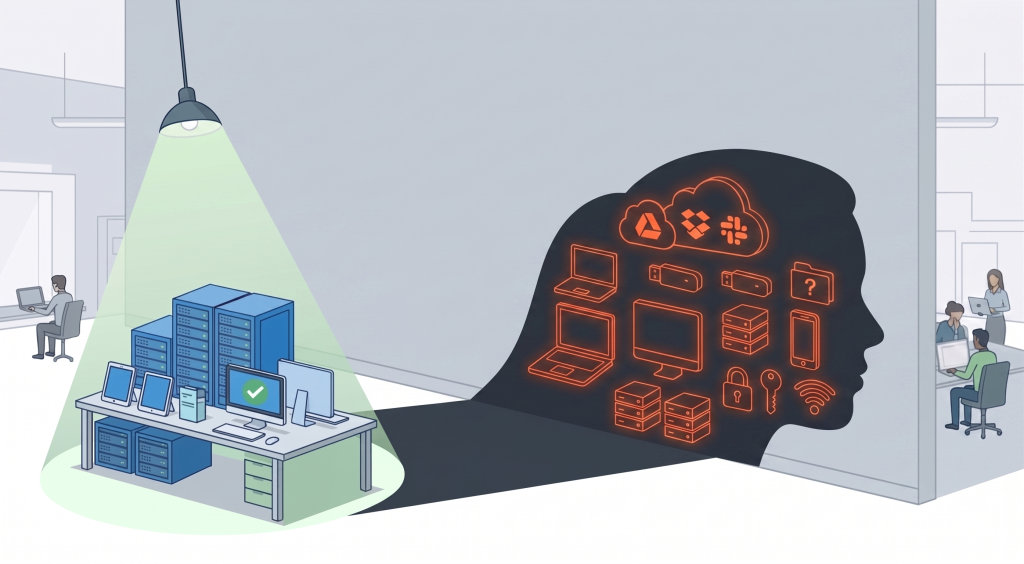
This is the birth of Shadow IT: the use of information technology systems, devices, software, applications, and services without explicit organizational approval. While it usually stems from a genuine desire to be more productive, it creates “silent security gaps” – vulnerabilities that quietly put your data, your reputation, and your compliance status at risk.
But Shadow IT is rarely just a security problem. It’s the most visible symptom of “app sprawl” – a bloated, disconnected technology environment. When employees feel forced to bring their own tools to work, that’s a glaring signal your current systems are failing them. So the real solution isn’t buying more security tools to block apps; it’s strategic IT consolidation: uniting your workforce under a single, efficient, and secure digital ecosystem.
What makes Shadow IT so insidious is its subtlety. There are no flashing red lights on a server dashboard, no ransom demands locking your screens. The risk grows incrementally instead, with every unauthorized account created and every unmonitored file shared. For executives and board members, this creates a dangerous false sense of security. You believe your perimeter is locked down with expensive firewalls, while in reality a parallel, invisible IT infrastructure is holding some of your most sensitive operational data.
Quick Diagnosis: 3 Warning Signs of App Sprawl
Wondering whether your company has a Shadow IT problem? In our experience, three signs show up first:
- The expense report trail: You regularly see small, decentralized credit card charges for SaaS tools (Asana, Slack, Canva) coming from non-IT departments.
- The “access denied” bottleneck: Workflows stall because employees share generic links to documents that require a personal login, or data is “stuck” on a colleague’s personal drive.
- The ghost accounts: During offboarding, you discover that former employees still have active access to client communication groups or project boards on unauthorized platforms.
The Anatomy of a Silent Security Gap
To understand why these gaps are “silent,” look at how modern enterprise security is built. Traditional security protects a “fortress” – a defined perimeter where IT controls the entrance and exit. Shadow IT effectively builds a secret back door your IT team doesn’t know exists.
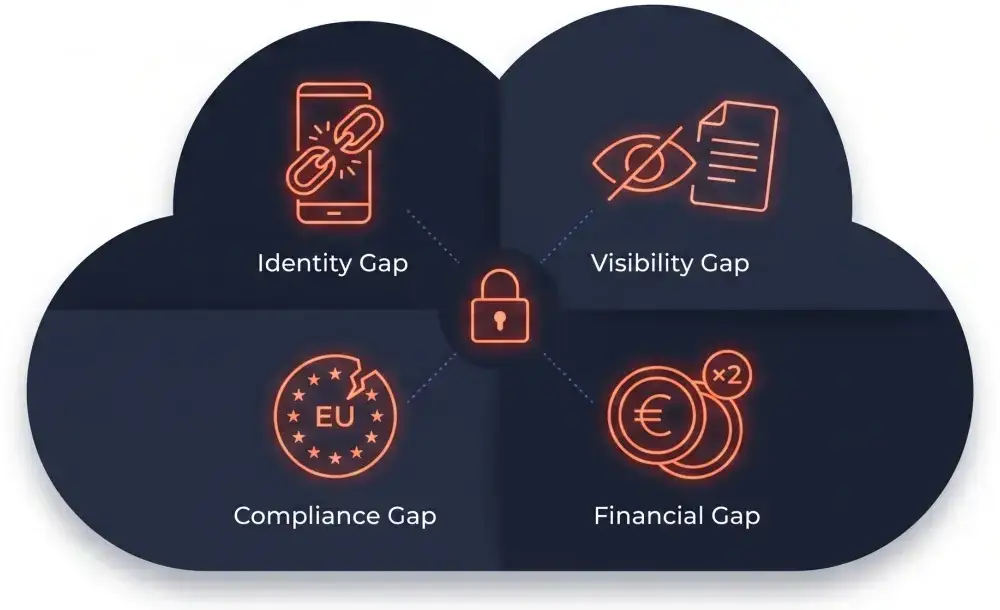
1. The Identity Gap: Unmanaged Access
In a sanctioned environment, employee access is managed through a central directory (like Microsoft Entra ID or Google Workspace). When an employee is promoted, their permissions change; when they leave, their access is revoked globally with one click.
Unauthorized apps run on personal identities. An employee using a personal Evernote to store meeting minutes, or a personal Trello to track project milestones, is using an identity you do not own. If that employee is terminated, they walk out the door with your corporate intelligence still active on their smartphone.
Personal accounts also lack the enterprise-grade enforcement your IT team relies on. A user might protect their shadow app with a weak, reused password and no multi-factor authentication. If those personal credentials are compromised in an unrelated third-party breach – and reused passwords eventually are – attackers suddenly have access to your corporate meeting notes, strategic plans, or client lists. And your IT department won’t receive a single alert, because the breach happened outside your system.
2. The Visibility Gap: Unmonitored Data Flow
Most silent gaps are invisible to traditional monitoring. Modern cloud apps communicate over the same standard web protocols as legitimate business browsing. To a standard firewall, an employee uploading a sensitive PDF to a personal cloud looks exactly like an employee reading a news site. Without specialized tools like Cloud Access Security Brokers (CASBs), management stays blind to the outbound migration of corporate data.
Consider the typical lifecycle of a document here. A financial report is downloaded from a secure corporate portal, then uploaded to a personal Google Drive so the employee can work on it from their home iPad over the weekend. To the firewall, this is just a standard secure web session. The company has now lost the ability to track who views, edits, or shares that document. And if that employee accidentally generates a “public link,” the resulting leak is completely untraceable with standard network monitoring.
3. The Compliance Gap: GDPR & Data Governance
For businesses operating in Cyprus and the wider EU, GDPR requires strict oversight of how and where personal data is processed. Data is legally allowed to cross borders, but you must guarantee it stays protected by approved legal safeguards wherever it travels. Shadow IT often uses “freemium” software that stores data in jurisdictions with weak privacy laws. If your staff is inadvertently storing client data in a non-compliant cloud, your business is legally liable for a breach – even if the software was “free.”
This also creates a serious blind spot during legal discovery or compliance audits. If a client exercises their “right to be forgotten,” your IT team can systematically wipe their data from the CRM and local servers. But if that client’s details are sitting in a sales rep’s personal Mailchimp account or a decentralized spreadsheet on a shadow cloud, you can’t delete what you don’t know exists. The company is exposed to severe penalties for failing to comply – despite executing the request perfectly on its official systems.
4. The Financial Gap: Redundant SaaS Licensing
Security risks frighten the CEO; wasted money motivates the CFO. Shadow IT creates real financial redundancy. A company might be paying premium enterprise rates for a comprehensive suite (like Microsoft 365, which already includes Teams, SharePoint, and OneDrive). Meanwhile, different departments are quietly expensing Slack, Asana, and Dropbox on corporate cards. You’re paying twice – or three times – for overlapping functionality.
And the subscription cost is the small part. Finance teams waste hours chasing receipts, reconciling decentralized expenses, and juggling dozens of vendor contracts with varying renewal dates. When a department buys independently, it bypasses procurement, so the company misses out on volume discounts and favorable enterprise terms. Worse, Shadow IT creates invisible “technical debt”: when a rogue app is eventually abandoned, or a department is finally forced to migrate back, IT spends unbudgeted, expensive engineering hours untangling that scattered data. What looked like a “cheap” €15/month subscription can ultimately cost thousands in migration, recovery, and lost productivity.
The Cost of Inaction: Quantifying the Shadow IT Drain
When management treats Shadow IT as an “IT nuisance” rather than a business vulnerability, the financial bleeding accelerates. The cost of inaction is measurable, and it hits the bottom line in three ways:
- Direct SaaS waste: Industry estimates put wasted SaaS spend at a meaningful share of the total – and you don’t need the headline figure to confirm it. Pull your own subscription list and the duplicates will be obvious. Every company we audit has them.
- Hidden labor costs: When data is scattered across personal drives and unauthorized chat apps, employees lose hours just hunting for the right version of a file. Meanwhile your IT team ends up acting as “digital janitors,” recovering lost data from departing employees’ personal accounts instead of working on anything strategic.
- Catastrophic risk exposure: The biggest financial risk is regulatory. If a Shadow IT account is breached and EU citizen data is exposed, you’re liable for fines of up to €20 million or 4% of global turnover. On top of that, failing to secure third-party applications violates the Digital Operational Resilience Act (DORA), exposing executives and board members to direct liability.
Ignoring the problem doesn’t hold the status quo. It compounds your financial and legal liability every month.
The Management Challenge: Why “Banning” Fails
The traditional instinct is to enforce a strict “no.” But in a world of remote work and high-speed mobile connectivity, a total ban isn’t just impossible to enforce – it’s counterproductive. Honestly, banning apps never works. It pushes the behaviour underground, where you can see even less of it.
1. Data Fragmentation: The Loss of Corporate Intelligence
When teams splinter off into unauthorized apps, your company’s “collective brain” begins to fragment. Strategic insights, customer feedback, and project history get trapped in silos management can’t search or analyze. This erodes the long-term value of your intellectual property.
Picture a senior account manager who abruptly resigns. They’d been running key client communications through a personal WhatsApp group because it was “faster.” When they leave, the incoming account manager inherits no historical context, no record of promises made, no relationship roadmap. The company hasn’t just lost an employee; it has lost years of proprietary relationship data.
2. The Recruitment Risk: Frustrating Tech Drives Churn
Today’s best people expect modern, friction-free tools. If your corporate IT feels like a relic from 2010, high performers will either ignore your policies to get their work done or leave for a company with a more modern stack. Shadow IT is often a symptom of technology frustration.
Think of a brilliant new marketing executive hired to revamp your campaigns. They’re used to modern, real-time, collaborative software. If they arrive on day one and are handed clunky legacy systems that crash constantly, their enthusiasm plummets. Within weeks they’ll either find a workaround by buying their own subscription, or they’ll start looking for a new job.
3. The Integration Nightmare: Blocking Digital Transformation
Modern management increasingly relies on automation and AI to scale. But AI can only analyze data it can actually reach and has permission to see. When your corporate data is fragmented across dozens of unauthorized apps, integration becomes a liability. APIs may technically let you connect a personal WhatsApp thread to an official CRM, but doing so violates security and compliance protocols. The fragmentation keeps your company blind to its own data – and fundamentally unable to use next-generation technology.
Say your COO wants to deploy an enterprise AI assistant – a Microsoft Copilot, for instance – to generate quarterly business reviews from ongoing project data. If your team is officially supposed to use the sanctioned CRM, but the actual day-to-day feedback, file sharing, and approvals are happening in unauthorized Slack workspaces and personal drives, the assistant produces a blank or wildly inaccurate report. You’ve invested thousands in AI, and because its “brain” can’t reach the scattered shadow data, the investment is useless.
The Bigger Picture: Shadow IT vs. Consolidated Ecosystems
Before executing a consolidation strategy, it helps to picture the end goal clearly. Moving away from Shadow IT isn’t about taking tools away from employees; it’s about upgrading them to a professional, unified standard.
Here’s the contrast between a fragmented Shadow IT environment and a consolidated one:
| Strategic Category | The Shadow IT Environment | The Consolidated IT Ecosystem |
|---|---|---|
| Data Control & Visibility | Scattered blindly across personal devices and unvetted consumer clouds | Centralized, searchable, actively monitored, fully backed up |
| User Lifecycle (HR/IT) | Manual, error-prone offboarding that leaves orphaned accounts | Automated, one-click provisioning and revoking via a central directory |
| Compliance & Legal | High GDPR/DORA risk; can’t honour “right to be forgotten” | Fully auditable, compliant, protected by enterprise data governance |
| Financial Efficiency | High waste (paying 2x or 3x for duplicate tools and expensing hidden software) | Optimized (maximizing the ROI of a single enterprise license) |
| AI & Automation Readiness | Inefficient; AI yields incomplete, unreliable insight from fragmented silos | Future-proofed; AI reads unified data to generate real business insight |
Seen side by side, the case is clear: IT consolidation isn’t an expense, it’s an investment in operational maturity.
Strategic Solutions: A 5-Step Consolidation Roadmap
If prohibiting apps doesn’t work, how does a managing director close these silent gaps? The shift is from control to governance.
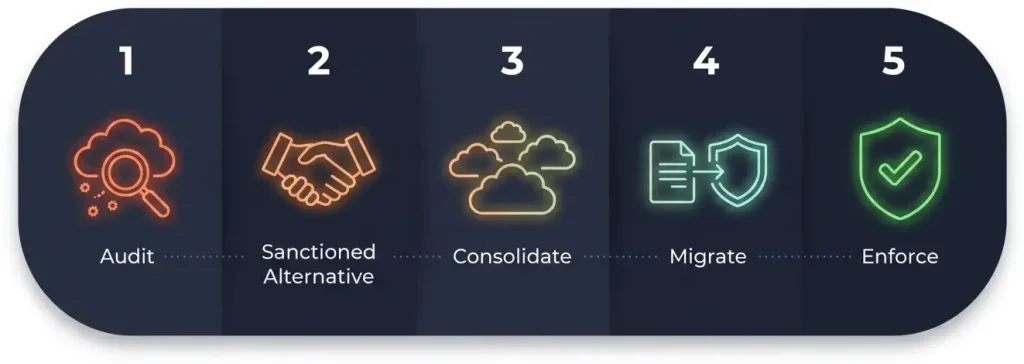
Step 1: Conduct a “Usability Audit”
Shadow IT is a roadmap. If 30% of your marketing team is using an unauthorized design tool, that’s a clear signal the sanctioned tool is inadequate. Instead of reprimanding the team, ask: “What does this tool give them that our current stack doesn’t?” Treat Shadow IT as free market research for your internal IT strategy.
In practice: We had a client whose HR team was using a free online PDF-merging tool to combine sensitive employee documents. The fix wasn’t to block the website. They simply lacked a proper licensed PDF editor – so a secure Adobe Acrobat license solved the workflow bottleneck and eliminated the risk of uploading confidential HR data to a random third-party server.
Step 2: Implement “Sanctioned Alternatives”
The most effective way to close a gap is to offer a better, safer bridge. If employees are using WhatsApp for internal chat, give them a robust, secure alternative like Microsoft Teams or Slack with proper enterprise controls. When the official tool is just as easy as the shadow tool, people naturally gravitate back to the secure environment.
In practice: Sales teams love shadow messaging apps because they’re instant and mobile. Banning them just pushes the behaviour further underground. Instead, roll out the Teams mobile app, show them how to set up dedicated client channels, and demonstrate how it logs conversations into your CRM automatically. Give them something equally mobile-friendly that actually reduces their admin, and the transition happens on its own.
Step 3: Scale to Ecosystem Consolidation
Once you start replacing unauthorized apps with sanctioned ones, avoid playing whack-a-mole. Swapping individual shadow apps one by one just builds a fragmented, expensive software library. Scale the strategy toward ecosystem consolidation instead.
In practice: Standardize the company on one comprehensive platform (Microsoft 365 or Google Workspace) where chat, file sharing, video conferencing, and identity management are natively connected. When the official ecosystem is cohesive and frictionless across departments, the urge to reach for outside tools disappears.
Step 4: Execute Migration & Decommissioning
Consolidation is an active process. You can’t just buy the new software and expect people to move over. Management has to map where data is hiding in, help departments migrate that critical data into the new central hub, then mandate the official closure of the unauthorized accounts. That’s what permanently seals the gap.
In practice: Your marketing team might have three years of brand assets sitting in an unauthorized Google Drive created by a former manager. If IT simply blocks Google Drive at the firewall, work grinds to a halt. Instead, provision a dedicated, secure SharePoint site, work with the department to map a structured migration for those 500GB of files, and train the team on the new structure. Only once they’re comfortably working in the sanctioned system do you mandate permanent deletion of the old drive.
Step 5: Enforce Zero Trust and CASB
Technically, management should support a move toward Zero Trust – a framework that assumes no device or user should be trusted by default, inside the office or out. Layering a Cloud Access Security Broker (CASB) on top lets IT see which cloud apps are in use and automatically block high-risk transfers while allowing productive ones.
In practice: A remote employee is working from hotel Wi-Fi. Zero Trust verifies their identity via multi-factor authentication before granting access to the corporate server. Later, they try to download a spreadsheet of sensitive client data and upload it to a personal Dropbox to work offline. The CASB detects the sensitive data type in real time, blocks the upload, and pops up a reminder of the corporate data policy. You’ve prevented a GDPR breach without IT lifting a finger.
The Boardroom Perspective: Protecting the Bottom Line
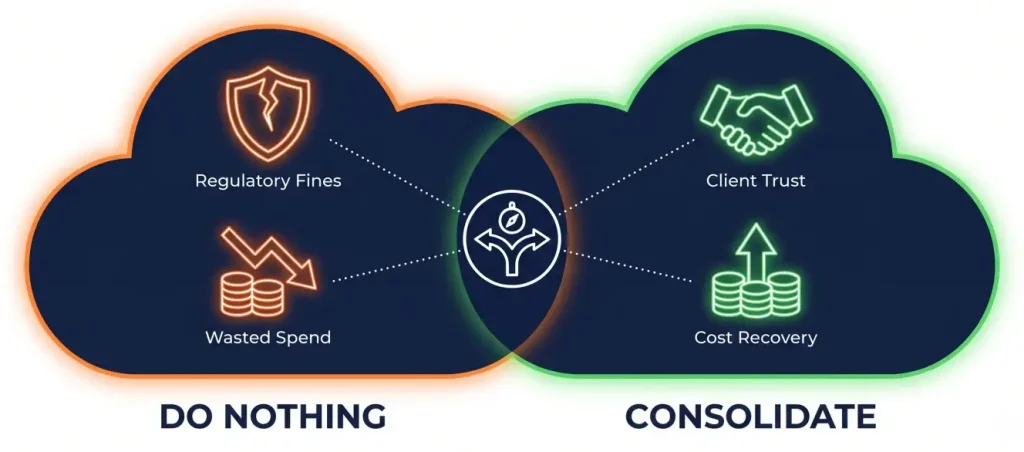
Ultimately, Shadow IT is a business risk, not just an IT one. Addressed through the lens of employee enablement and IT consolidation, it turns from a hidden threat into a driver of digital transformation. Closing these silent gaps yields clear returns:
- Regulatory fines: Mitigates the risk of GDPR penalties (up to 4% of annual global turnover) and ensures DORA compliance.
- Reputational damage: Protects client trust by keeping all data within a secure, auditable perimeter.
- Operational friction: Un-silos fragmented data, speeding up decisions and preventing costly contextual errors.
- Vendor ROI & cost reduction: Cuts operational overhead by terminating duplicate subscriptions and reducing the number of vendor contracts your IT and Finance teams have to manage.
To drive this transformation, the boardroom has to mandate a phased approach – and the sequence matters as much as the technology. First, prioritize discovery: audit the environment to learn exactly which shadow tools employees are using and, more importantly, why. Second, focus on enablement: invest in a consolidated, enterprise-grade ecosystem that genuinely solves the friction driving staff away from official channels. Only then, once the right tools are in place and critical data has been safely migrated, should IT deploy enforcement mechanisms like Zero Trust and CASB to lock down the perimeter.
Listen, enable, then enforce. Follow that order and the cultural transition is smooth, turning a major vulnerability into a streamlined, cost-effective advantage. When IT shifts from obstacle to enabler, Shadow IT fades on its own. The goal was never to stop people using technology; it’s to make sure they use the right technology in a way that protects the future of the firm.
How NMORE Can Help Consolidate Your IT Infrastructure
At NMORE, we specialize in finding these silent gaps, on-site for Cyprus-based enterprises and remotely worldwide. Our consulting team doesn’t just look at your servers; we look at your workflows. We build comprehensive IT consolidation roadmaps to audit your current app sprawl, migrate scattered data into secure, unified environments, and equip your staff with tools that are compliant, cost-effective, and high-performing.
Don’t wait for a compliance audit to reveal your hidden risks. Contact Nmore today to schedule a usability audit and start closing your silent security gaps.
 Copy Link
 Share on X
 Share on Facebook
 Share on LinkedIn